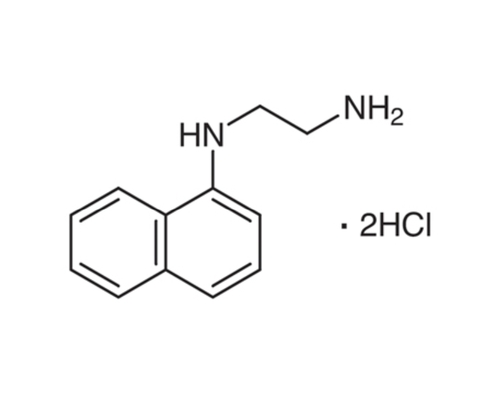
About N (1-Naphthyl) Ethylenediamine Dihydrochloride
| Property | Value |
| Specification | N-(1-Naphthyl)Ethylenediamine Dihydrochloride (NEDA) |
| Other names | NEDA chemical, N1-NAPTHYL ETHYLENE DIAMINE DIHYDROCHLORIDE |
| CAS | 1465-25-4 |
| Molecular Formula | C12H14N2.2HCl |
| Molecular Weight | 259.18 |
| Appearance | White to off white powder or crystal |
| Loss on drying | Max. 5% |
| Assay (On dry basis) | Min. 98% |
| M.P. | 190-197C |
| Sulphated Ash | Max. 0.1% |
Analytical Uses and BenefitsPrimarily applied as an analytical reagent, N (1-Naphthyl) Ethylenediamine Dihydrochloride facilitates colorimetric detection of nitrite ions using the Griess reaction. Its high sensitivity and reliable performance make it a preferred choice in laboratories for precise quantitative analysis, ensuring clear results in environmental and chemical testing.
Safe Storage and StabilityThis compound exhibits excellent stability when stored as recommended-tightly closed, shielded from light, in cool, dry conditions. These measures protect its purity and maintain its analytical performance throughout its shelf life, which extends to at least two years under proper storage protocols.
Quality Assurance and PackagingOffered in 25g, 100g, and 500g bottles, each batch comes with a certificate of analysis and lot number upon request. This process maintains traceability and guarantees that the product aligns with international standards, providing confidence in both research and industrial applications.
FAQ's of N (1-Naphthyl) Ethylenediamine Dihydrochloride:
Q: How should N (1-Naphthyl) Ethylenediamine Dihydrochloride be stored to ensure maximum stability?
A: It should be stored tightly closed, protected from light, and in a cool, dry environment to maintain its stability and purity for at least two years.
Q: What is the primary benefit of using this compound in laboratory analysis?
A: Its main advantage is its high sensitivity and reliability in colorimetric detection of nitrite ions via the Griess reaction, facilitating accurate quantitative analysis.
Q: When is a certificate of analysis and lot number provided for this product?
A: A certificate of analysis and lot number are provided upon purchase and can be requested for specific batches, ensuring quality assurance and traceability.
Q: Where can this analytical reagent be sourced from in India?
A: It is available through exporters, manufacturers, suppliers, and traders within India who offer various packaging sizes and support documentation.
Q: What process is used to detect nitrite ions with this product?
A: Nitrite ions are detected colorimetrically using the Griess reaction, which involves the development of a colored compound, enabling quantitative measurement in sample solutions.
Q: Is N (1-Naphthyl) Ethylenediamine Dihydrochloride hazardous or poisonous under standard laboratory conditions?
A: Under normal laboratory conditions, it is considered non-hazardous and non-poisonous, which ensures safe handling during analytical procedures.








 Send Inquiry

 Send Inquiry


